
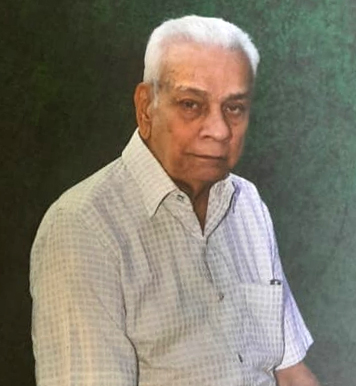
The first cry of a baby is known as vagitus. This sacred sound is one of the most anticipated moments for parents. My parents were Sri Hariraya Kamath and Smt. Shyamala Bai. I was born on May 1, 1946, in Kasaragod, which was then part of the erstwhile South Kanara under British rule. This period marked the peak of the Indian Independence movement. My parents named me Kasaragod Anantha Kamath. There was something special about my name-Anantha was said to be given on an Anantha Chathurdashi day, a divine day according to the GSB calendar.
Our home was located near the Sri Varadaraja Venkatramana Temple, close to the railway station in Kasaragod. The Sri Varadaraja Venkatramana Temple played a crucial role in shaping my aims and ambitions. I was very fortunate to have our home on the sacred premises of the Lord’s Temple. This abode of worship played a vital role in molding my life, a topic I shall return to later.
My father worked as a clerk in a timber mill called Laxmi Sawmills near the Railway Station. The vicinity of the mill was beautiful, with brackish water, a river, and the sea all in close proximity. An old tile company, Islamiah Tile Company, operated near this mill. The smoke tower of that company was very tall and impressive to see. My father’s factory produced wooden frames for slate frames and other wood products. Many women came to the timber mill to collect wood dust, which they used as fuel for their sigdis (specially made earthen and iron stoves) to cook in their kitchens. These two mills provided employment for many in the locality. Both companies were located behind the Kasaragod railway station.
Could you just imagine what the scene must have been like at the station during that time? The first platform was on the western side, while the area where the present second platform stands was originally a small railway station with very limited facilities. This station had the only railway track constructed by the British. The second track was added much later, after a long gap. A couple of trains were plying between Mangalore, Madras and Trivandrum. The steam engine train, which generated a heavy fog while it ran, was like a volcano spitting dark, black fog. The engine was powered by steam generated by water heated by charcoal. A huge water tank was built behind the railway station to supply water to the train from either side. One or two residential quarters for railway officials were also located behind the platform.
This abode of beauty lies on the banks of the Chandragiri River, also known as the Payaswini River, and along the sands of the Arabian Sea. A railway track passed near my home, and
when the train moved along it, the entire area was filled with a resounding quackling sound. The engine’s distinctive crackling was truly terrific at that time. I still love that train and its sound an experience the new generation no longer has. The trains and station there held many stories about me. Each whistle of the train carried memories of my childhood, echoing through the town like a familiar tune. The sight of passengers peering out of the windows, waving at children playing near the tracks, remains vivid in my mind. Even today, the distant sound of a train brings a sense of nostalgia, transporting me back to those golden days. It was more than just a mode of transport-it was part of our lives, connecting people, places, and countless emotions.
Sri Varadaraja Venkatramana Temple (SVVT), Malik Deenar Great Juma Masjid, and Mother of Sorrows Church were near our house.
My residence was in a well-known area where you could see the Kasaragod Fort and the Kasaragod Railway Station, with the Arabian Sea and the Chandragiri River nearby. Could this place, where I live, be considered my homeland? I am grateful to my respectful ancestorss for having found such a beautiful place for us to call home. I truly believe that it is the divine blessing of Lord Venkatramana and Lord Kodandarama.
Brahmass. We ONEs protected and served each other. This unity has been maintained to this day. Unfortunately, the mamber of GSB residents has been dwindled to only a few. The same is the true for Ceramics Road near Theruvath, where in the past few decades, a large number of people from the Salya community (weaving community) resided. They were all weavers by their gotra profession. A wooden weaving instrument called magga was used inside their homes or in sheds near their homes.
In those days, there was a Weavers’ Cooperative Society on Mallya’s Lane. The weavers used to supply the clothe they wove to this society. The clothes they produced wert exceptionally durable and had a first-class appearance Now the Saliya population in the area has diminished concentrated mainly along Ceramics Road, and is now ver small in number. Sri Cheerumba Bhagavathi Temple, located there, stands as a true testament to their glorified past. Thi highlights the imminent danger of the extinction of both the GSBs and Saliyas, who are concentrated in specific areas. This can be seen as a radical change in history, one that should no have taken place as far as these communities were concerned