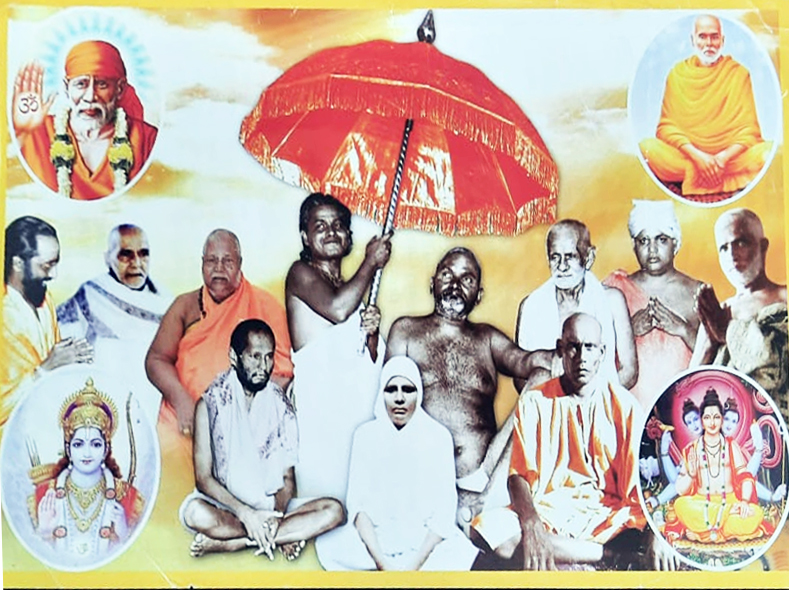
Great Great Reverend deciple of Avadhoota Sri Sri Nithyananda Swamiji.
Sri Bhagawan Nithyananda is said to have been an incarnation of Lord Siva. Still others say he was an incarnation of Lord Vishnu, Still others claim that he was the very incarnation of Lord Krishna. Once Shri M P Pandit (From Aurobindo Ashram) has translated and Shri P. Ramanath Pai has published this as an English version of Chidakash Gita as ‘Voice Of The Self’. Swami Chinmayananda written a forward to this. In his foreward, Swami Chinmayananda says, ” Bhagawan Nithyananda is equal to one hundred Krishnas. He does not have birth or death. Words fail to describe him. Bhagawan Nithyananda is a live Bhagvad Gita.” Is it any wonder that, when people pressed Bhagawan Nithyananda about such details, he responded by saying, “You want me to tell you about myself? How is that possible when I have realized that I am in everything and there is nothing around me in which I don’t find my own Self?” He went on to say that his parents and brothers were those who loved God and worked to serve God. There are many stories about how Bhagawan Nithyananda arrived on this Earth plane. When people made attempts to verify these stories, Baba usually admonished them, stating that such details are important only to curiosity-seekers. And yet on one occasion,in response to questions about his birth, he was heard to sat ” Two crows come and went”.
After arriving here on this Earth plane, Bhagawan Nithyananda spent several years in the South Kanara district in Quilandy. From there, he moved about quite a bit ( mostly on foot and by train), making his way deep into the Himalaya’s and staying for a time in places such as Quilandy, Sri Lanka, Burma, Kanhangad, Kumbla, Gokarna, Udupi, Calicut, Mangalore, Manjeshwar, Coastal Karnataka and Vajreshwari. Later he settled in Ganeshpuri, at the foot of the majestic Mandakini Mountain near the Bhimeshwar temple, surrounded by rolling hills, lush fields and hot springs. At the time he first went to Ganeshpuri it was still a jungle, practically uninhabitable, except for such a sage.
It is said that around 1897-1900, in late November or early December,an elderly women was out picking flowers and collecting wood in the dense jungle near Quilandy. As she approached a nearby tree, she heard two crows cawing loudly. It was as if the crows were purposely making a ruckus to get her attention. So, she followed the cawing of the crows and found herself standing in front of a river. There she saw a baby boy floating on a large leaf. This was narrated by Bhagvan to one of his devotees. The women picked the child up and took the baby boy to the safety of her home. Unniamma accepted the baby as her own. Unniamma worked in Pantalayini near Calicut,in a region called Quilandy. She cleaned the local temples and also worked as a housekeeper in the household of a local attorney,Ishwar Iyer.She named him Ram. Ram was cared for by Ishwar Iyer. Ishwar Iyer was well known in Quilandy for his work a lawyer and he was also very religious. His chosen deity was Surya Narayana ( the Sun God), and Mr.Iyer diligently engaged in worship throughout each and every day. He also introduced the young Ram to many scriptures and the study of sacred texts on which discourses were given in his home. Late in his life, Ishwar Iyer decided to make pilgrimages to several holy Shrines. He took the young Ram with him. After visiting several holy Shrines, they reached Kashi. Ram was about age 10 at the time. Just as Ishwar Iyer decided it was time for them to return home, Ram told him that it was time for them to part. He told Ishwar Iyer that He wanted to spend time in the Himalaya’s and that he would return to him at the appropriate time. Shocked and dismayed, Ishwar Iyer tried to change Ram’s mind, but to no avail. He then left Ram and returned home. The young Ram then spent several years in the Himalaya’s, travelling on foot and meditating in the holy caves there.
When Ram returned to Quilandy several years later at age 16, Ishwar Iyer had taken I’ll and was on his deathbed. Just before passing, he told Ram he wanted to see the Sun God, Lord Surya, in all his splendor, and he asked Ram to grant him that boon.Then he had a profound vision of Surya Narayana. In ecstasy, the old man exclaimed “You have brought Ananda (Bliss) to me. You are Nithyananda! May you be Nithyananda to all!” This is how Bhagawan Nithyananda got this name, that he later said was not a name, but a state ( the Eternal Bliss of The Absolute).
After visiting other places, Including Sri Lanka and Burma, Swami Nithyanand returned to Quilandy again. By this time he was already known as a great Kundalini Yogi and Avadhoot. From Quilandy he went to Kanyakumari, Calicut, Tellichery, Cannanore and Kanhangad. He then appeared in Kumbla. It is during this time that he started to attract large crowds of people. He performed miracles, healing the sick and alleviating the suffering of the masses. He also stopped trains, slept comfortably on a rope tied between two windows and was found levitating in a barn. In Villages where people had no drinking water, Bhagawan Nithyananda created wells with running water, in places where there was no sign of water. These wells have never run dry, despite the fact that they are not attached to any water sources. He attributed these miracles to God and the faith of his devotees.
In Mangalore, Thulasi Amma met Bhagawan Nithyananda and became his devoted disciple. This led to the events in which the Chidakasha Gita was recorded for posterity. Baba spent time in Mulki, Padubidri, Bantwal and then Udupi. In Udupi he was often seen in and around the famous Sri Krishna temple. At first, he was not always welcome there. The priests of the temple thought him to be a mad man and attempted to scare him away by arranging to have him stoned. As the hired hands threw stones at Bhagawan Nithyananda, the stones disappeared before hitting him, or sometimes they turned into sweet meats before landing on the ground. Many of these same stones were then found around the feet of the Krishna Murti in the temple. This miracle confirmed that Bhagawan Nithyananda and Sri Krishna are one! Over time people from all over India flocked to Udupi to receive Baba’s blessings. He healed many of the sick and dying and gave special attention and love to the poor and indigent there.
Kanhangad: Swami Nithyananda then moved on to kanhangad where he spent several years. He selected kanhangad as the seat for his mother Ashram, stating that the Kanhangad Ashram is a University for sages and that, one day, sages from abroad will occupy the Ashram and make it hub for spiritual pursuit. He cleared the land around an old fort there with his bare hands and also participated in the building of the Ashram that is now located in a rocky hill. Bhagawan Nithyananda spent many days lying on a huge rock there in the hot sun, deep in the trance of meditation. Later with his own hands, he carved away the stone from inside of that rock to build the famous meditation caves that are still located there under the Kanhangad Ashram. With respect to the construction of the Kanhangad Ashram, there is a wonderful story. At that time, British still occupied India. As the caves were being completed and construction on the Ashram began, workers from the village were hired. There was no money to pay wages but Baba Manifested the workers wages in miraculous ways. Sometimes he would take the exact amount needed from his loincloth. At other times he told the workers to collect their wages from underneath a tree or rock. Each time the exact amount to pay each worker (not a paise more or less) was manifested. This was so startling that some observers believed the money was either counterfeit or stolen.
Guruvan : Bhagawan Nithyananda spent several years in Guruvan, located about 5 kilometers east of Kanhangad. In those days Guruvan was a jungle inhabited by wild animals and poisonous snakes. There was no water. One day Baba struck a rock with his hand and water started to gush out of the barren rocky hillside. Water has been flowing from that place ever since. This water is now a stream that forms into a pool. It was named “Papanashini Ganga” by Baba. Many go to this place to bathe, as it is considered to be as holy as the Ganges. Bhagawan Nithyananda said that, in the past, many Siddhas had come to live in Guruvan and took Mahasamadhi there. For this reason, he created a circle of Eight stone Pillars/lingams signifying the Ashta Siddhis. Guruvan is rightly considered a Thapobhumi. Later, Swami Janananda Baba,the one who Bhagawan Nithyananda had appointed to run the Ashram and all administrative and financial affairs,cleared the land at Guruvan and turned it into a beautiful garden with a temple.
After completing construction of the caves and the Kanhangad Ashram, Bhagawan Nithyananda set off on tour, leaving the Ashram to be further developed and run by Swami Janananda. Nithyananda Baba then visited most of the holy Shrines in India. Later he was seen in Mumbai, Akroli and Vajreshwari, before settling in Ganeshpuri, where he spent the remainder of his years before taking Mahasamadhi there on August 8, 1961.
Om Namo Bhagawathe Nithyanandaya